
Currently Empty: $0.00
How to Increase Wheel Loader Productivity on Job Sites
A wheel loader that should fill a truck in five passes is taking seven. Multiply that across a full shift, then across a fleet, and you’re looking at thousands of dollars in wasted fuel, time, and labor — every week. The frustrating part? The machine is rarely the problem. Productivity losses almost always trace back to technique, setup, site layout, or maintenance that quietly drags performance down.
This guide gives you a practical playbook for getting more out of every wheel loader on your site. You’ll learn how to sharpen operator technique, configure the machine correctly, lay out the site for fast cycles, prevent the downtime that kills output, and use technology to find hidden losses. Each section ends with takeaways you can put to work on your next shift.
Start by Measuring Cost Per Ton
Before you change anything, know your baseline. The single most useful productivity metric for a wheel loader is cost per ton moved — not hours worked or loads counted.
To find it, track three things over a typical shift: tons moved, fuel burned, and operating hours. Most modern loaders report fuel and hours on the dash or through telematics. Pair that with truck scale data or known bucket loads, and you have a number you can actually improve against.
Why this matters: a loader that looks busy isn’t always productive. Measuring cost per ton reveals whether your changes are working or just feel like they are.
So what? Set your baseline first. Every tip below should move that number down.
Sharpen Operator Technique
The operator influences productivity more than any other single factor. Two operators in identical machines can post wildly different numbers, and the difference is almost always technique.
Master Smooth Bucket Filling
The fill is where good cycles are won or lost. Aim to load the bucket in one smooth, continuous motion rather than ramming the pile and stalling the hydraulics.
- Approach the pile square and at a steady speed
- Drive the bucket in low, then crowd and lift together so the bucket fills as it rises
- Let breakout force do the work — forcing the bucket wastes fuel and time
- Aim for a full bucket on the first attempt; “topping off” with a second bite kills cycle time
A skilled operator fills the bucket in about three to four seconds without spinning the tires. Wheel spin means lost traction, wasted fuel, and accelerated tire wear.
Cut Cycle Times with the Right Pattern
The shortest cycle is a tight, repeatable one. The V-pattern — where the loader and truck form a V around the stockpile — minimizes travel and turning.
- Position the truck close to the pile, angled 45 to 60 degrees
- Keep travel distance short; every extra foot multiplies across hundreds of cycles
- Carry the bucket low while traveling for stability and visibility
- Begin raising the bucket as you approach the truck, not after you stop
Position for Efficiency
Good positioning eliminates wasted movement. Reset the truck and stockpile relationship as the pile shrinks so you never travel farther than necessary. Use articulated steering to line up the bucket rather than reversing and re-approaching.
Real-world example: a quarry loader cutting its cycle from 35 seconds to 28 — by tightening the V-pattern and filling cleanly — moves roughly 20% more material in the same shift, on the same fuel.
Takeaway: smooth fills, short cycles, and tight positioning are the fastest free productivity gains you’ll find.
Configure the Machine Correctly
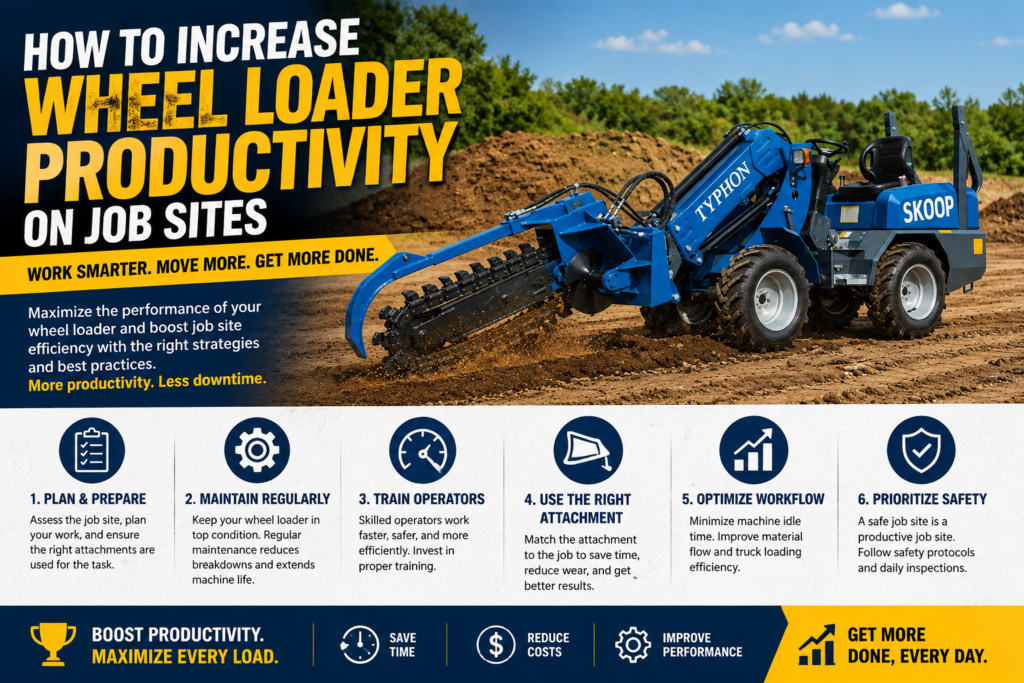
Even a great operator loses ground on a poorly set-up machine. Match the configuration to the material and the work.
Right-Size the Bucket
A bucket that’s too big stalls the loader and forces partial fills. One that’s too small wastes cycles. Match bucket capacity to both the material density and the loader’s rated capacity.
- Light material (mulch, snow, light aggregate): a larger, high-volume bucket fills fully without overloading
- Dense material (wet sand, rock, compacted soil): a smaller bucket reaches full weight without straining the machine
- Aim for full, complete bucket loads — partial loads are the most common hidden productivity killer
Match Attachments to the Job
The quick-coupler is an advantage only when you use the right tool. Forks for pallets, a grapple for irregular material, a high-dump bucket for tall trucks. Before running any hydraulic attachment, confirm the loader’s auxiliary flow and pressure meet its requirements — a mismatch means sluggish performance.
Don’t Overlook Tire Pressure
Tires are the cheapest productivity lever most fleets ignore. Underinflated tires increase rolling resistance, burn extra fuel, and wear out faster. Overinflated tires reduce traction at the pile.
- Check pressure regularly and set it to the load and surface
- Watch for uneven wear, which signals alignment or pressure problems
- On abrasive surfaces, consider tire chains or specialized tires to protect a major recurring cost
Takeaway: the right bucket, the right attachment, and correct tire pressure can lift output before the operator changes a thing.
Optimize Site Layout and Workflow
The site around the loader often costs more productivity than the machine itself. Loaders spend a surprising amount of time traveling, turning, and waiting — all of which good layout reduces.
Build Smart Haul Roads and Loading Areas
- Keep the loading zone firm, level, and well-drained so the loader gets traction and clean fills
- Minimize the distance between stockpile and truck
- Maintain travel paths to avoid the bouncing and slowdowns that rough ground causes
- Give the loader room to use its turning radius without reversing repeatedly
Position Trucks to Eliminate Waiting
The loader should never wait on a truck, and the truck should never wait on the loader. Stage trucks so the next one is ready as the current one pulls away.
- Set up a clear approach and exit path so trucks don’t cross the loader’s path
- Position trucks for a short, square loading swing
- Where volume justifies it, use a two-truck exchange so loading never pauses
Manage Stockpiles for Easy Loading
A well-shaped stockpile fills buckets faster. Keep piles high and tight rather than spread flat — a steeper face lets the bucket fill in one clean pass. Push material back into the pile periodically so the loader always works a productive face instead of chasing scattered material across the yard.
Real-world example: a ready-mix plant that repositioned its aggregate piles and trucks to cut loader travel by 30 feet per cycle gained nearly an hour of productive loading per day — with zero change to the machine or operator.
Takeaway: shorten travel, eliminate waiting, and keep stockpiles tight. Layout fixes are often the largest gains available.
Prevent the Downtime That Kills Output
The most productive loader is the one that’s running. Unplanned downtime — a blown hose, an overheated engine, a flat — stops not just the loader but every truck and process depending on it.
Run Disciplined Daily Checks
A few minutes before each shift prevents hours of lost work:
- Check engine oil, hydraulic fluid, and coolant levels
- Inspect tires for pressure, cuts, and wear
- Look for leaks and inspect hoses and fittings
- Clean the radiator and coolers — loaders work hard and generate serious heat
- Inspect the bucket cutting edge and teeth
Stay Ahead with Scheduled Maintenance
Worn components quietly steal productivity long before they fail. Dull cutting edges slow bucket fills. Clogged filters reduce power. Loose articulation joints waste motion.
- Replace cutting edges and teeth on schedule for clean, efficient loading
- Grease the center joint and lift linkage per the manufacturer’s intervals
- Change filters and fluids on time to protect power and hydraulics
- Address small leaks and noises before they become breakdowns
Takeaway: maintenance isn’t a cost center — it’s uptime, and uptime is productivity. A well-kept loader runs thousands of productive hours; a neglected one fails early and often.
Use Technology and Telematics
Modern loaders generate data that points straight at productivity losses. The fleets getting the most output are the ones acting on it.
- Payload weighing systems show real-time bucket weight, so operators load full, accurate buckets and avoid overloading or under-filling.
- Telematics reports fuel burn, idle time, engine hours, and fault codes — revealing exactly where productivity and money leak away.
- Idle tracking is often the fastest win: many loaders idle 30% or more of their run time, burning fuel and hours while producing nothing.
- Fault-code alerts let you schedule service proactively instead of reacting to breakdowns.
Real-world example: a fleet manager who reviewed telematics found one loader idling 40% of its hours. A simple operator conversation and an auto-idle-shutdown setting cut fuel use noticeably within a week — no new equipment required.
Takeaway: you can’t improve what you don’t measure. Use payload and telematics data to find the losses hiding in plain sight.
Invest in Operator Training
Technique drives productivity, and technique is trainable. Skilled operators fill faster, cycle tighter, burn less fuel, and break fewer machines.
- Train new operators on smooth bucket filling and efficient cycle patterns from day one
- Have experienced operators coach pile approach, positioning, and tight V-patterns
- Use payload data to give operators concrete feedback on full-bucket consistency
- Reinforce low-idle habits and gentle, fuel-conscious operation
A capable operator can outproduce an untrained one by a wide margin in the same machine — making training one of the highest-return investments you can make.
Takeaway: the operator is your biggest variable. Invest there, and every other improvement pays off faster.
Common Mistakes to Avoid
- Accepting partial bucket loads. The most common hidden loss. Aim for full, clean fills every cycle.
- Long travel distances. Reposition stockpiles and trucks to keep cycles short.
- Letting the loader idle. Idle time burns fuel and hours with zero output.
- Ignoring tire pressure. A cheap fix that affects fuel, traction, and wear daily.
- Running dull cutting edges. Worn edges slow every single bucket fill.
- Reacting to breakdowns instead of preventing them. Daily checks and scheduled service cost far less than downtime.
Put These Gains to Work
Wheel loader productivity comes down to four levers you control: how the operator runs the machine, how the machine is configured, how the site is laid out, and how well you prevent downtime. None of them require buying a new loader — they require attention to the details that quietly add up across every cycle, every shift, every season.
Start with one step this week: measure your cost per ton, then pick the single biggest loss you can see — partial bucket loads, long travel, or excess idle time — and fix it. Confirm the gain in your numbers before moving to the next. Stack these improvements one at a time, and you’ll move more material at a lower cost per ton with the equipment you already own. That’s the kind of return that shows up directly on your bottom line, shift after shift.
Safety and Compliance
- Occupational Safety and Health Administration (OSHA): https://www.osha.gov/ (Great for linking to safety standards, PPE requirements, and heavy equipment operation rules).
- National Safety Council (NSC): https://www.nsc.org/ (Excellent for citing workplace injury statistics and preventative safety measures).
- 811 Call Before You Dig: https://call811.com/ (Essential for any article discussing excavation, trenching, or utility work).
Heavy Equipment and Manufacturing
- Association of Equipment Manufacturers (AEM): https://www.aem.org/ (Perfect for linking to equipment data, telematics standards, and manufacturing industry trends).
- Associated Equipment Distributors (AED): https://www.aednet.org/ (Useful for content related to equipment rentals, sales, and dealership standards).
Road Construction and Materials
- Federal Highway Administration (FHWA): https://www.fhwa.dot.gov/ (The ultimate authority for road building specs, infrastructure data, and highway quality standards).
- Asphalt Institute: https://www.asphaltinstitute.org/ (Ideal for articles about road rollers, asphalt temperature, compaction density, and paving techniques).
- National Asphalt Pavement Association (NAPA): https://www.asphaltpavement.org/ (Great for citing sustainability in road building and best practices for paving crews).
General Construction Industry Data
- Associated General Contractors of America (AGC): https://www.agc.org/ (Excellent for citing economic impact, workforce training data, and broad construction industry news).