
Currently Empty: $0.00
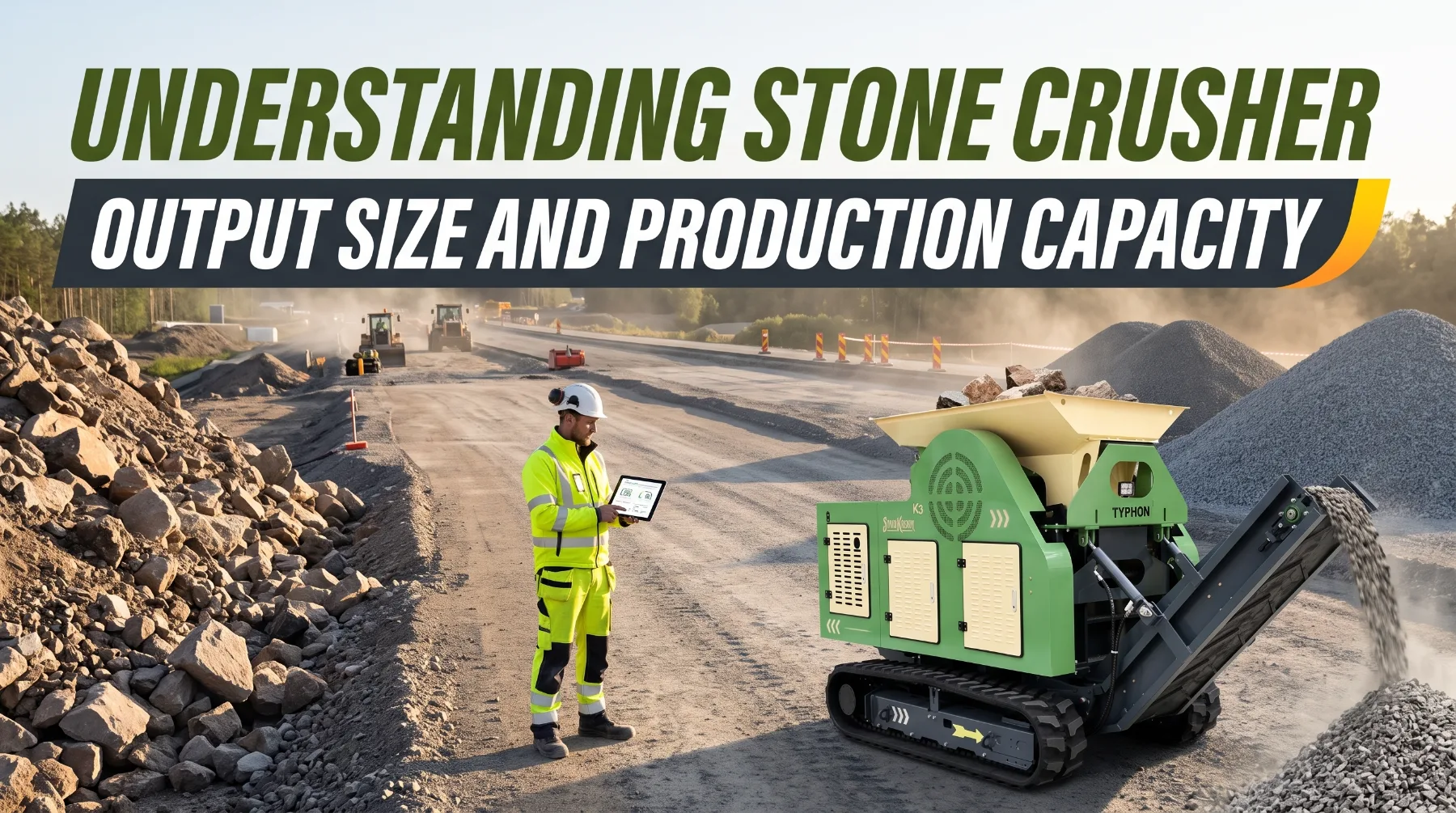
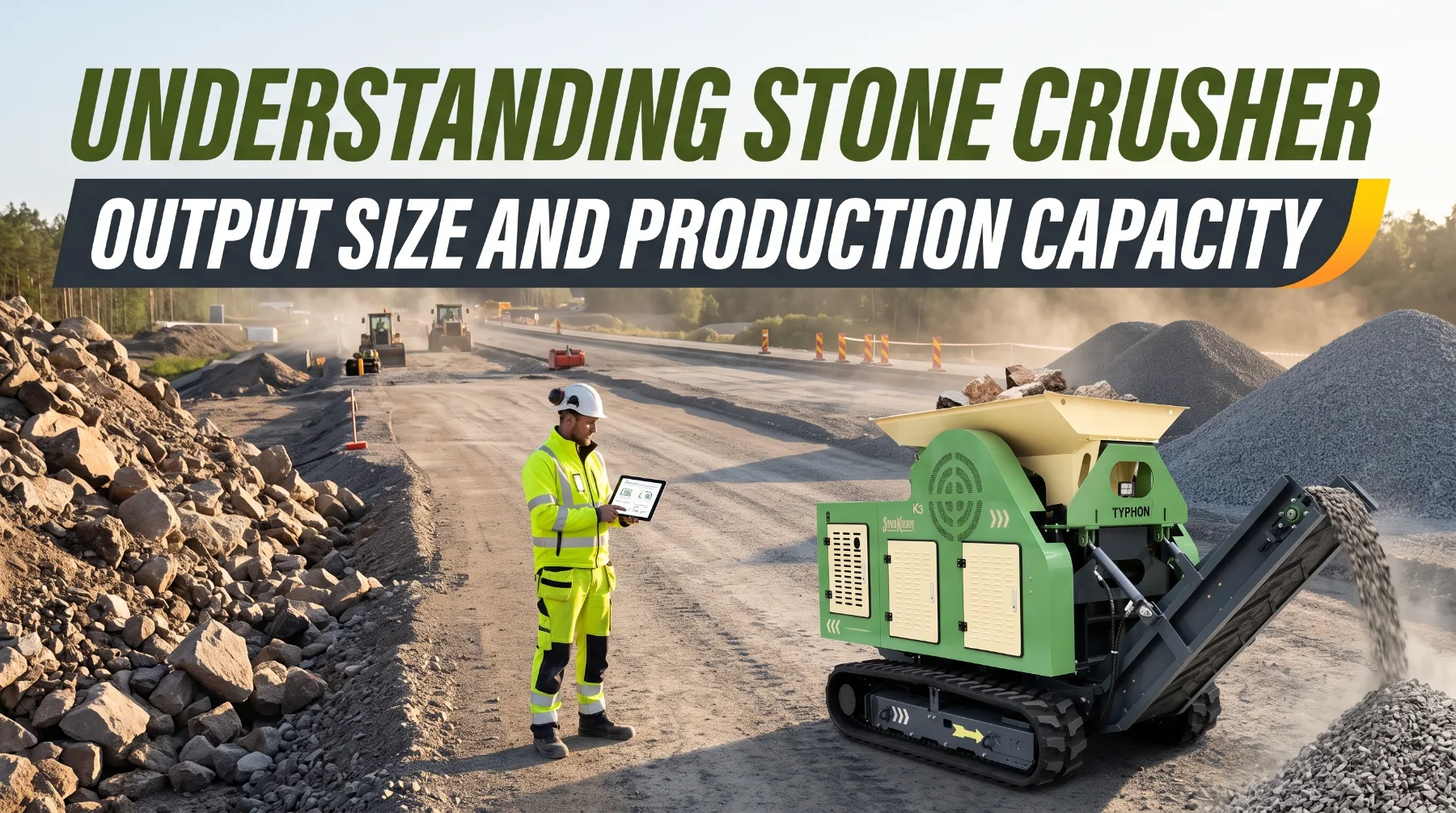
Producing a crushed base for a rural road project can make a crusher's rated capacity seem like the main factor in scheduling. Actual production, however, can vary when the rock is harder than expected, the material is wet, or the loader feeds the hopper inconsistently. Output that is too coarse can also require additional processing, reducing the amount of usable aggregate produced during the shift.
Several conditions influence how much material a stone crusher can process effectively. Feed material properties, moisture, feed consistency, crusher settings, and required output size all affect production. A crusher may reach its rated tons-per-hour capacity under suitable conditions, but harder material or a smaller required output can reduce practical throughput.
Planning around real site conditions helps create a more realistic production schedule. Contractors should consider the type and condition of the feed material, target output size, loader feeding method, and expected operating conditions when estimating daily production. Understanding these factors helps align crusher capacity with actual project requirements and reduces the risk of falling behind schedule.
Understanding Crusher Output Size
Output size is the approximate size range of material that leaves the crusher after processing. It describes the finished product, not the amount of material produced. A crusher does not normally produce one exact size. Instead, it creates a range of particle sizes, from larger pieces down to smaller particles and fines.
Different applications call for different output ranges:
- Road and driveway base often requires a graded mix of sizes that compacts well and creates a stable surface.
- Drainage stone typically needs cleaner and more uniform material that leaves enough space for water to flow through.
- Fill material may accept a wider range of sizes, depending on project requirements and how the material will be used.
- Landscaping and pathways may require specific sizes based on appearance, stability, and walkability.
Crusher design and adjustment settings influence the output range. Many machines allow operators to change the discharge opening, which can make the finished material finer or coarser. The type and condition of the feed material can also affect the final particle size.
Before crushing, operators should confirm the required material size for the project. After production begins, checking the output early can help identify whether the crusher needs adjustment. Regular checks are useful when feed material changes or when consistent product sizing is important.
Key takeaway: Output size refers to the approximate range of material produced after crushing. Understanding the required finished size helps operators set the crusher correctly and produce material that matches the needs of the application.
Feed Material Affects the Final Product
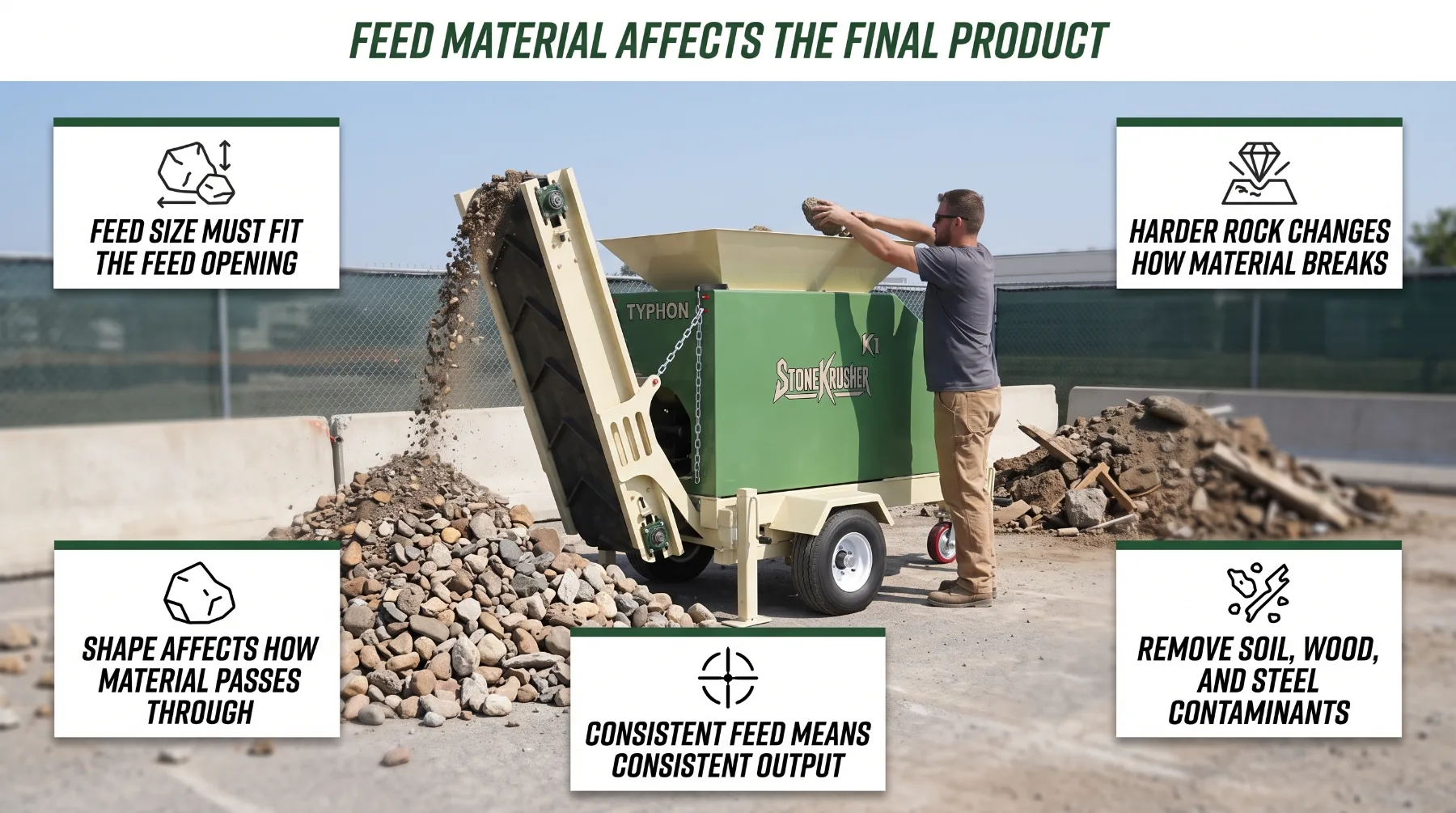
What goes into the crusher shapes what comes out. Feed material can vary in size, hardness, shape, and composition, and each of these factors affects both processing efficiency and the consistency of the finished material.
Large feed pieces need more work to reduce. Pieces close to the limit of the feed opening can slow production or cause bridging, where material jams across the opening. Very hard rock places greater demands on crushing components and may change how the material breaks. Flat or elongated pieces can pass through differently than blocky, rounded rock. Mixed material, such as rock combined with soil or clay, can lower output quality and affect machine operation.
Inconsistent feed often leads to inconsistent output. When the incoming material changes from load to load, the finished product can drift outside the target range. Sorting the pile, removing oversized pieces, and clearing contaminants such as wood, steel, and debris all help produce a more uniform result. Check the crusher's feed opening and rated material capability before processing begins.
Key takeaway: Feed material varies in size, hardness, shape, and composition, and large or inconsistent feed can affect processing efficiency and the consistency of the finished material.
Production Capacity in Tons per Hour
Production capacity describes how much material a crusher can process over a specific period. It is commonly measured in tons per hour and helps contractors estimate how long a crushing job may take. Capacity is especially important when planning project schedules, equipment requirements, and material production targets.
Manufacturer capacity ratings are typically based on defined conditions, such as a specific material type, feed size, moisture level, and discharge setting. Real jobsites rarely match these conditions exactly. Actual production can vary depending on material hardness, moisture, feed consistency, crusher settings, operator experience, and operating conditions. For this reason, the rated capacity should be treated as a reference point rather than a guaranteed production rate.
A simple example shows why realistic estimates matter. Suppose a project needs 3,000 tons of crushed base. If the crusher averages 40 tons per hour under actual working conditions and runs for 8 productive hours per day, it produces about 320 tons per day. The job would take roughly 10 working days. If wet or harder rock reduces the average production rate to 30 tons per hour, daily output drops to about 240 tons, extending the project to roughly 13 working days.
Production capacity can also change during the same project as the feed material or operating conditions change. Monitoring actual output helps contractors adjust schedules, labor, and equipment use when necessary.
Key takeaway: Production capacity shows how much material a crusher can process over time. Using realistic site conditions instead of relying only on the manufacturer's maximum rating helps contractors create more accurate schedules, production targets, and project estimates.
Material Conditions Influence Crushing Rate
The same crusher can perform very differently from one site to the next. Material conditions have a direct effect on how quickly rock moves through the machine and how much finished product it delivers.
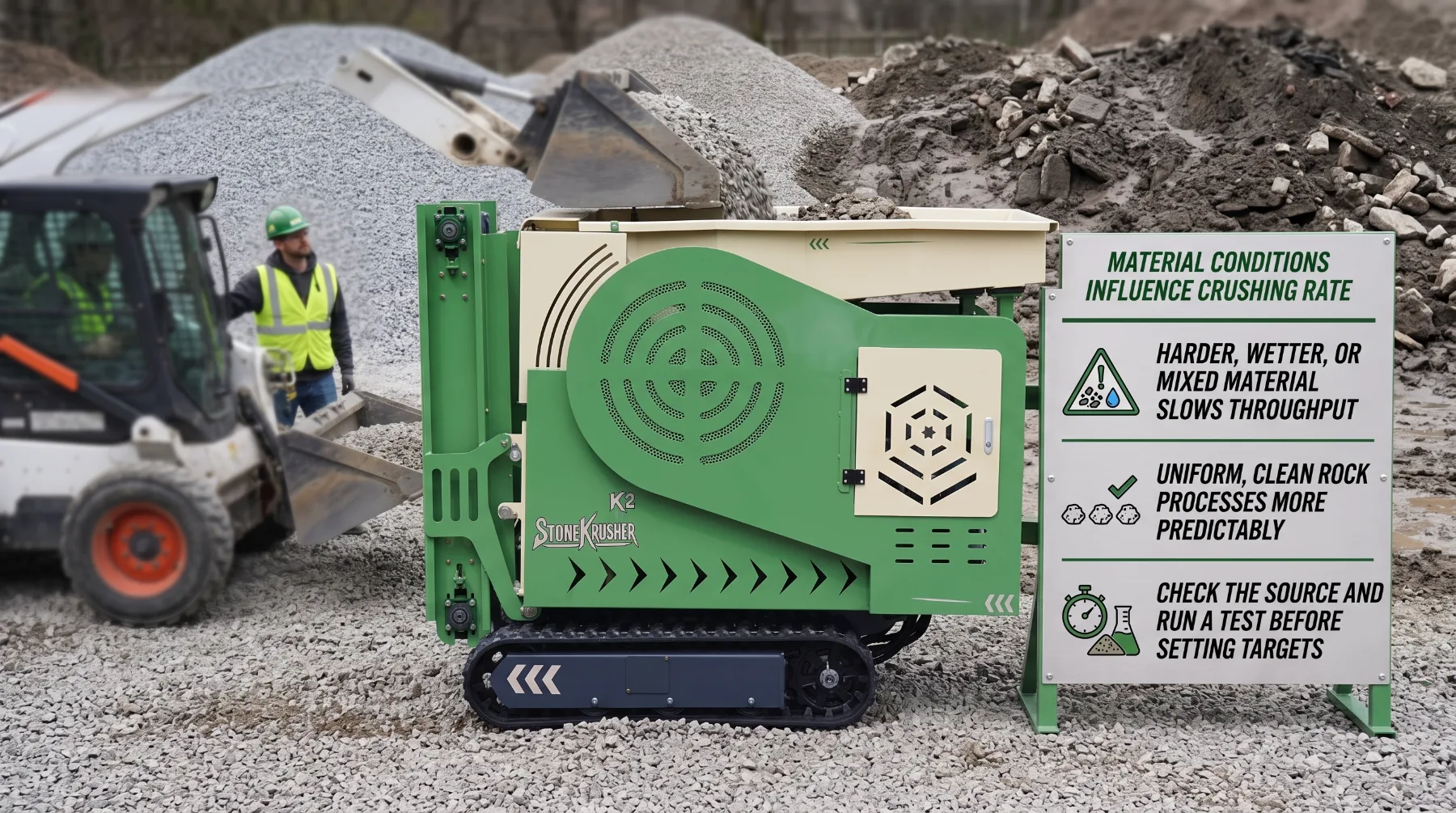
Several conditions affect crushing rate:
- Hardness: Harder rock takes more effort to break and can slow throughput.
- Moisture: Wet material, especially with clay or fines, can stick, clog, and reduce flow.
- Density: Denser material weighs more per load, which affects tonnage and handling.
- Consistency: Uniform material processes more predictably than mixed or irregular feed.
A machine processing clean, uniform rock may produce noticeably more than one handling wet, hard, mixed, or irregular material. Evaluate the material before you commit to a schedule. Look at the rock source, note recent weather, and check how much soil or debris is mixed into the pile. Where possible, process a test run and measure real output before setting production targets.
Key takeaway: Rock hardness, moisture, density, and material consistency affect crusher performance, so uniform material may process differently from wet, hard, mixed, or irregular material.
Conclusion
Stone crusher output size and production capacity describe different aspects of crushing performance, with output size defining the finished material and capacity indicating how much material can be processed over time. Crusher design and configuration influence the output range, while feed size, hardness, shape, moisture, density, and consistency affect both product quality and actual production rate. Before operation, contractors should confirm the required output size and tonnage, inspect feed material for oversized pieces and contaminants such as wood or steel, configure the crusher for the target product, and position loading equipment to provide a steady supply into the intake. Actual production rates can vary from rated capacity depending on material and operating conditions, so monitoring output size and recording tons produced provides a more reliable basis for production planning. Exclusion zones around feeding and crushing areas should also be maintained, while operating, maintenance, and safety procedures should follow the manufacturer's requirements. Matching crusher configuration, feed conditions, output specifications, and realistic production rates helps maintain consistent material quality and efficient crushing performance.
Frequently Asked Questions
What does stone crusher output size mean?
Output size refers to the approximate size range of material produced after crushing. It is influenced by the crusher's design, adjustment settings, feed material, and operating conditions. A crusher normally produces a range of particle sizes rather than one exact dimension. The required output depends on the application, such as road base, drainage stone, fill, or landscaping. Operators should adjust the crusher and monitor the finished material to make sure it meets the project's requirements.
How is stone crusher production capacity measured?
Production capacity is commonly measured in tons per hour (TPH) and indicates how much material a crusher can process over a specific period. The rated capacity provides a useful benchmark for estimating production and planning project schedules. However, the actual amount processed may be lower or higher depending on material characteristics, feed size, feeding consistency, crusher settings, and operating conditions. Contractors should use realistic production rates when estimating daily output and total project time.
What affects stone crusher production capacity?
Production capacity can be affected by material hardness, moisture, feed size, feeding consistency, loading method, crusher settings, and overall operating conditions. Hard or oversized material may require more crushing effort and slow the processing rate. Wet or sticky material can also affect material flow through the crusher, while inconsistent feeding may leave the machine underloaded for periods of time. Regularly monitoring the feed and output can help operators maintain more consistent production.
Is output size the same as production capacity?
No. Output size describes the approximate dimensions or size range of the crushed material, while production capacity describes how much material the crusher can process over a specific period. For example, a crusher may produce a certain aggregate size while processing several tons per hour. Output size is mainly concerned with the finished material, while production capacity is concerned with processing volume. Both specifications should be considered together to ensure the crusher produces the required material at a rate that supports the project's schedule.