Currently Empty: $0.00
Operating Techniques for Consistent Tri Loader Lifting and Material Transport
Material handling is a regular part of construction, landscaping, agriculture, and property maintenance. Moving pallets, gravel, mulch, soil, and other supplies requires equipment that can maneuver through restricted access areas while keeping loads stable. Efficient handling depends not only on machine capability but also on how operators position, lift, carry, and unload materials.
Safe operation involves understanding rated capacity, keeping loads properly positioned, and selecting attachments suited to each task. Travel speed, ground conditions, turning space, and load height also affect machine stability and handling accuracy. Smooth control inputs and suitable travel routes help reduce spills, unnecessary strain, and contact with nearby obstacles.
Consistent results start with checking the machine's capacity and attachment compatibility against the materials being moved. Operators should keep loads within rated limits, travel with the load positioned safely, and inspect the route for slopes, soft ground, and obstructions. Following the operator's manual for the specific model, along with regular equipment inspections and proper operating practices, helps reduce wear and maintain safe, productive material handling.
Understand Rated Operating Capacity
Every tri loader has a defined limit on how much it can safely lift and carry. That limit is the rated operating capacity, listed in the operator's manual and usually on a decal near the operator station. Many manufacturers also publish a tipping load, which is the weight at which the machine begins to tip forward. Rated operating capacity is set well below tipping load to give a safety margin, and it is the only figure operators should work to.
Capacity is not a single fixed number for every situation. It changes with attachment type, attachment weight, load position, lift height, and terrain. A pallet fork carrying a load far out on the tines reduces usable capacity compared with a compact load close to the carriage. Raising a load higher shifts the center of gravity and reduces stability, especially on uneven ground. Some machines also list different ratings for different configurations, such as with or without counterweights, so check the load chart for the exact setup you are using.
Know the weight of what you lift. Many common jobsite materials are heavier than they look. Wet soil, gravel, sand, and stacked pavers can reach a machine's limit long before a bucket looks full. Check pallet labels, delivery tickets, and material density figures when you are unsure. Never assume the machine can lift the same weight in every configuration, and never add unapproved counterweight or extra riders to compensate for an overloaded bucket.
Key takeaway: Work only to the rated operating capacity for your exact configuration, remember that capacity changes with attachment, load position, height, and terrain, and know the weight of every load before you lift it.
Position the Load Correctly
Load position affects balance as much as load weight. A load that sits off-center, extends far from the attachment, or shifts during travel can make a machine unstable even when it is within its rated capacity. Correct positioning keeps the center of gravity where the machine was designed to handle it.
Keep material centered on the attachment and as close to the machine as practical. With a bucket, fill it evenly rather than piling material to one side, and avoid heaping it so high that material spills during travel. With forks, set the tines as wide as the load allows, center them under the pallet, and slide the forks fully into the pallet so the load rests against the carriage. A load carried on the tips of the forks puts far more leverage on the machine and greatly reduces stability.
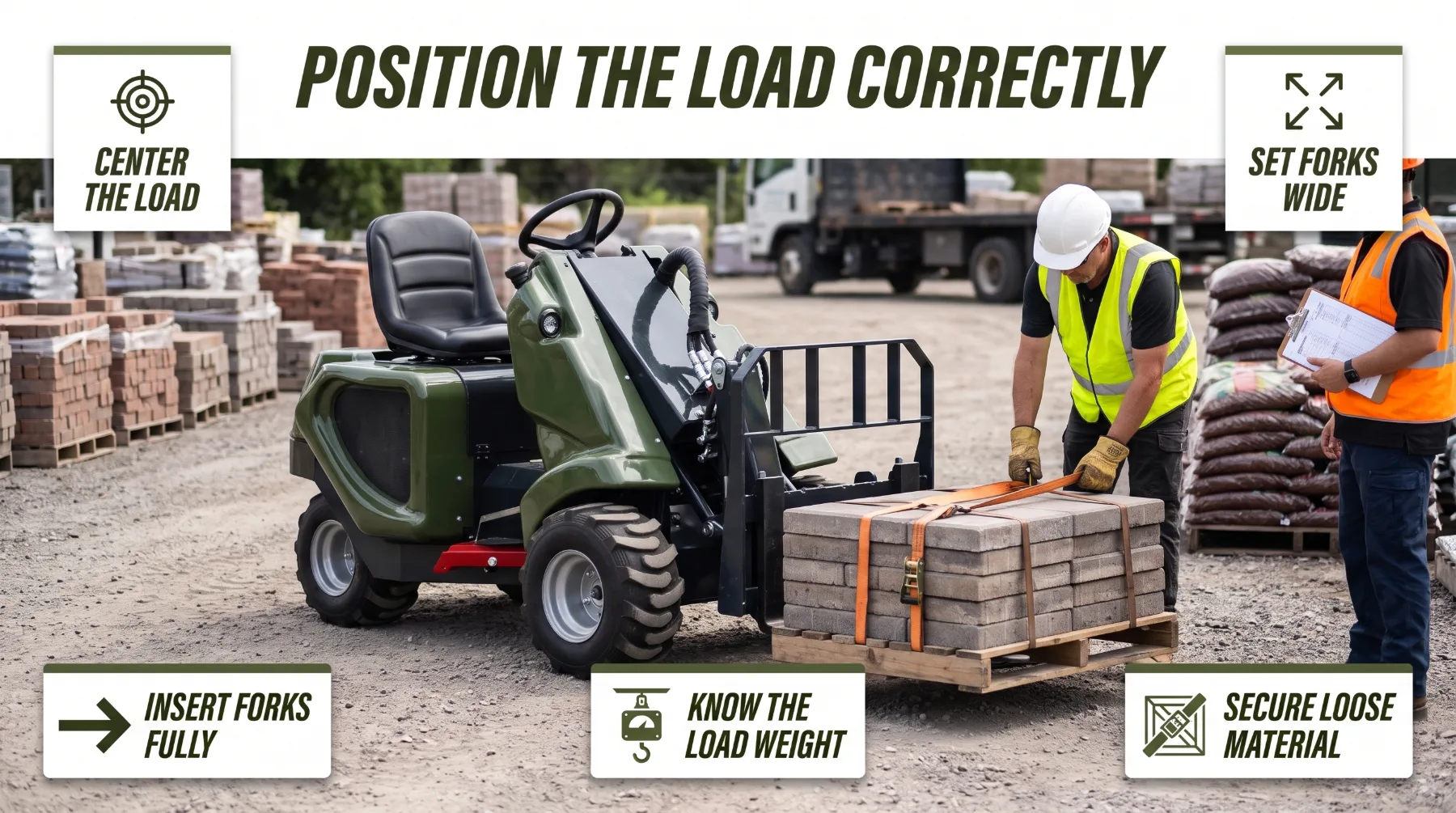
Secure loose or unstable material before moving it. Strap or wrap stacked items that could slide, and check that pallets are sound and not broken. Never carry long items such as pipe, lumber, or posts balanced across the attachment unless the attachment is designed for them and they are properly secured. Uneven or extended loads also add stress to the lift arms, pins, and hydraulic cylinders. Good positioning protects the machine as well as the operator.
Key takeaway: Keep loads centered, evenly distributed, and close to the attachment, set forks fully into pallets, and secure loose material before moving it.
Use Smooth Lifting Movements
Smooth control is the foundation of consistent lifting. Sudden joystick or lever inputs make loads swing, shift, or spill, and they can rock the machine at the moment it is least stable. Gradual movements keep material in place and give the operator time to react if something looks wrong.
Raise and lower the attachment at a steady, controlled pace. Begin each lift slowly, let the load settle, and then increase speed only as conditions allow. Avoid stopping a raised load abruptly, since the momentum can rock the machine forward. When curling a bucket or tilting forks, use small inputs and watch how the load responds. Feathering the controls takes practice, but it quickly becomes second nature and pays off in fewer spills and less rework.
Lift only when you are ready to place the load. Keep the attachment low while approaching the drop point, stop the machine, and then raise the load to placement height. Avoid driving, turning, or swinging the attachment with the load raised high. When dumping or placing material, do so slowly so the load releases evenly. Never allow anyone to stand under a raised load or attachment, and never work under raised lift arms unless they are supported as the operator's manual requires.
Key takeaway: Use gradual, controlled lifting and lowering, avoid abrupt stops, and raise the load to placement height only after the machine has stopped at the drop point.
Select the Correct Attachment
The attachment decides how efficiently a tri loader handles each task. Using the wrong tool slows work, increases spills, and can push the machine beyond its intended limits. Matching the attachment to the job is one of the simplest ways to improve consistency.
Buckets suit loose materials such as soil, gravel, sand, mulch, and compost. A general-purpose bucket handles most daily work, while a light-material bucket carries more volume of low-density material such as mulch or wood chips. Pallet forks are the right choice for palletized pavers, block, sod, and bagged products. Other compatible tools, such as grapples, augers, or rakes, extend the machine's use further when the job calls for them. Choose the attachment based on the material, the task, and where the load must go.
Before mounting any attachment, confirm it is approved for your machine. Check mounting compatibility, the attachment's own weight, and its rated capacity. A heavier attachment reduces the payload you can carry, since its weight counts against the machine's rated operating capacity. For hydraulic attachments, confirm that flow and pressure requirements match the machine's auxiliary system. Also consider visibility, since some attachments block the operator's view of the load or the ground ahead. Once mounted, verify that the coupler is fully locked before lifting anything.
Key takeaway: Match the attachment to the material and task, confirm compatibility, weight, capacity, and hydraulic requirements, and verify the coupler is fully locked before every lift.
Inspect the Machine Regularly
Consistent lifting depends on a machine that is in good working order. Worn pins, leaking hoses, low tire pressure, or a sticking control can change how a tri loader handles a load. A short inspection before each shift catches these problems before they affect performance or safety.
Walk around the machine with the engine off and the attachment lowered. Check tires for proper pressure, cuts, and wear, or tracks for tension and damage. Uneven tire pressure can make the machine lean or pull to one side under load. Inspect hydraulic hoses, fittings, and cylinders for leaks, cracks, and abrasion. Look over the lift arms, pins, bushings, and coupler for cracks, looseness, and excessive wear. Grease pivot points at the intervals the manufacturer specifies.
Then check the operator station and controls. Confirm that the seat belt or operator restraint works, that controls move smoothly and return to neutral, and that lights, the horn, and any backup alarm function correctly. Check fluid levels according to the manual. Report unusual noises, leaks, warning lights, or changes in how the machine lifts or travels before continuing work. Keep any machine with a safety-critical defect out of service until a qualified technician repairs it, and follow the service schedule to maintain dependable performance.
Key takeaway: Inspect tires or tracks, hydraulics, lift arms, pins, couplers, controls, and safety devices before each shift, and report any defect before continuing operation.
Maintain Suitable Travel Conditions
Most material transport time is spent traveling, and travel is where many tip-overs and spills occur. Ground conditions, speed, turning, and load height all affect stability. A planned route and disciplined driving keep loads secure and the machine upright.
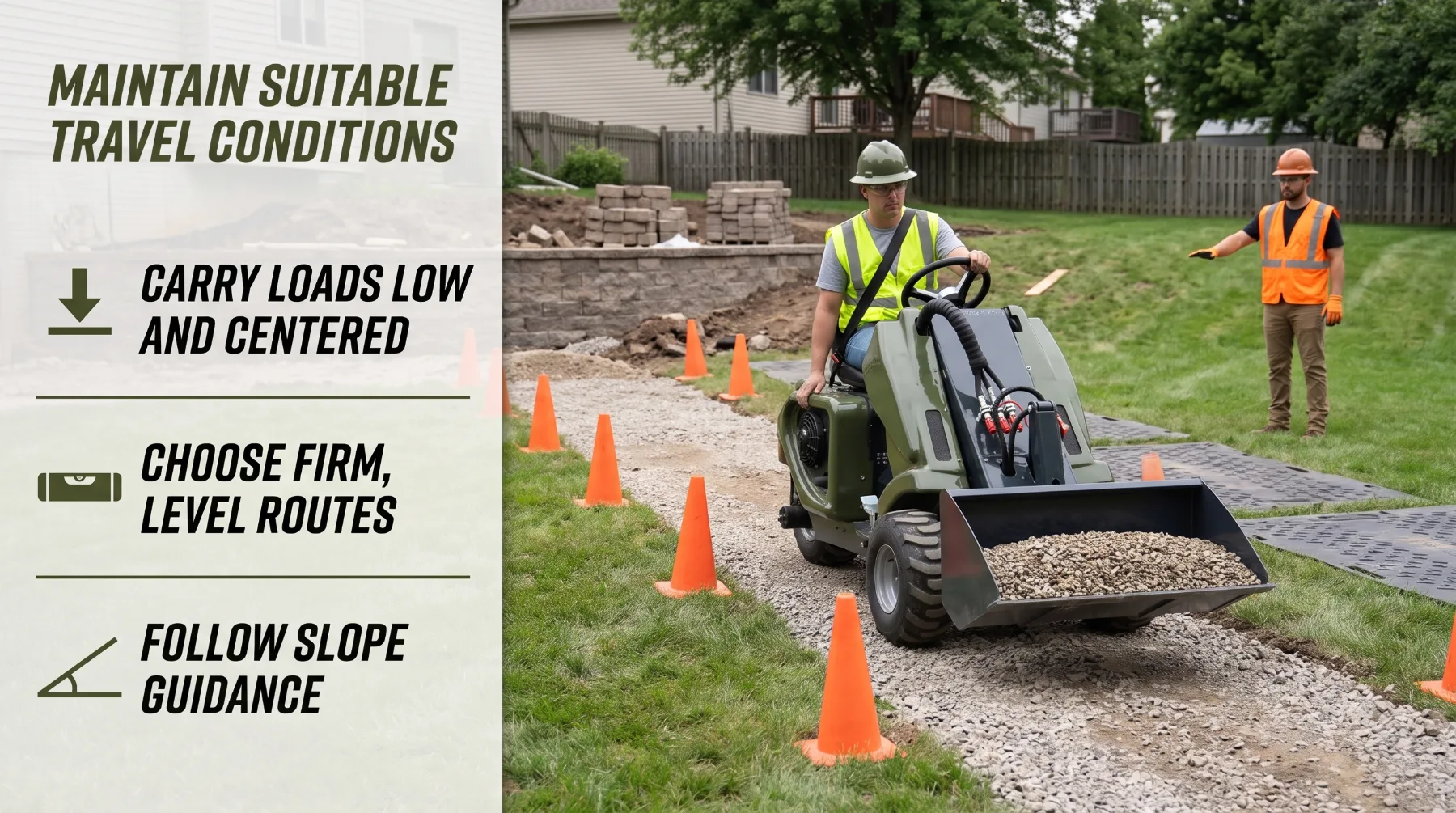
Carry loads low during travel. A load held just high enough to clear the ground and obstacles keeps the center of gravity down, improves stability, and gives the operator a clearer view of the travel path. Use firm, level routes whenever possible. Reduce speed on uneven, soft, or wet surfaces, and avoid sharp turns, especially with a full bucket or a pallet on the forks. Watch for holes, curbs, tree roots, irrigation heads, and debris that can jolt the machine or shift the load.
Follow the manufacturer's guidance for slopes and ground conditions. As a general practice, travel straight up and down slopes rather than across them, and avoid turning on a grade. With a loaded attachment, many manufacturers direct operators to keep the heavier end of the machine pointed uphill, so check your manual for the correct orientation. Stay well back from trench edges, retaining walls, embankments, and soft shoulders. Keep ground workers clear of the travel path, and use a spotter when visibility is limited or the route passes near people, structures, or vehicles.
Key takeaway: Keep loads low and centered during travel, choose firm and level routes, slow down on rough ground, avoid sharp turns, and follow the manufacturer's slope guidance.
Conclusion
Consistent tri loader operation comes from a set of disciplined habits. Operators who work within rated capacity, keep loads centered and close, use smooth controls, carry loads low on suitable routes, choose the right attachment, and inspect the machine daily move more material with fewer spills and less risk. Each technique supports the others, and together they protect the operator, the crew, the property, and the equipment.
Make these practices part of every shift. Review the load chart and capacity decal for your exact configuration, walk the travel route before moving material, and complete the daily inspection before the first lift. Your next step: post a simple pre-shift checklist covering capacity, attachment, route, and inspection in every tri loader your crews operate, so these techniques become standard practice on every job.
Frequently Asked Questions
Why should loads be carried low?
Keeping a load low lowers the machine's center of gravity, which improves stability. It also gives the operator a clearer view of the travel path and reduces the chance of a tip-over or spill.
Can a tri loader lift its rated capacity at every height?
Not necessarily. Capacity depends on the machine's rating and operating configuration, including attachment type, load position, lift height, and terrain. Always check the load chart for the exact setup you are using.
Which attachment is best for pallet handling?
Compatible pallet forks are commonly used, provided the load and attachment remain within rated limits. Set the tines wide, center them under the pallet, and slide them in fully so the load rests against the carriage.
How can operators improve lifting consistency?
Use smooth controls, center the load, follow capacity limits, carry loads low, and work on suitable ground. A daily inspection also keeps the machine responding predictably.