Currently Empty: $0.00
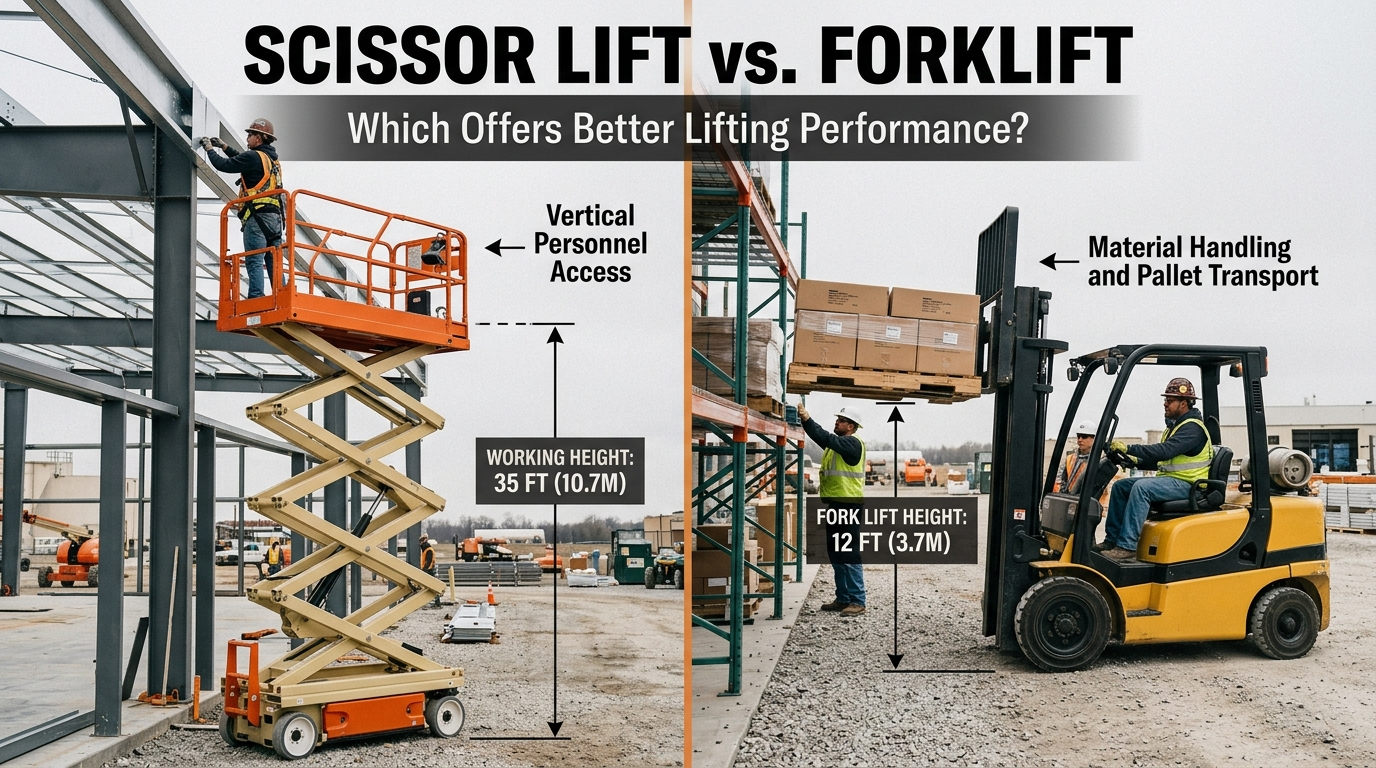
Scissor Lift vs. Forklift: Which Offers Better Lifting Performance?
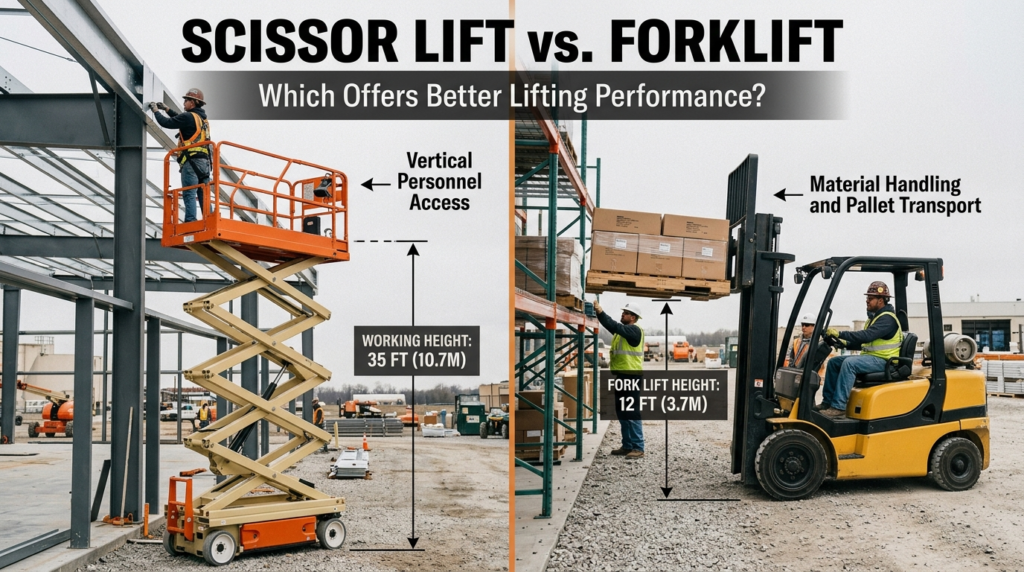
Choosing between a scissor lift and a forklift is rarely about which machine is better overall. It is about which one is right for the work in front of you. These two machines lift in fundamentally different ways and serve different purposes, so comparing their lifting performance means looking closely at what each is built to do. Get the match right, and the job moves smoothly and safely. Get it wrong, and you end up fighting the equipment rather than working with it.
This guide compares scissor lifts and forklifts across five practical areas. You will learn how their lifting capacity relates to load requirements, how their working height and vertical reach differ, what affects stability during lifting, how each handles maneuverability across various jobsites, and how to match the right equipment to your primary task. By the end, you will have a clear, dependable basis for choosing the machine that suits your work.
Lifting Capacity and Load Requirements
The rated lifting capacity of a scissor lift and a forklift reflects two very different jobs, so comparing them starts with understanding what each machine is built to carry. A scissor lift is designed to raise workers, their tools, and materials on a platform to an elevated work area. Its rated capacity accounts for the combined weight of the people and equipment on the platform. A forklift, by contrast, is built to lift and transport heavy loads, and its rated capacity describes how much weight the forks can raise, often at a specified load center.
Because the two machines carry loads so differently, the type, weight, and dimensions of what you need to move should guide your choice. A forklift excels at handling dense, heavy loads such as pallets, crates, and bulk materials, moving them efficiently and raising them to storage or loading heights. A scissor lift is not intended for this kind of concentrated material handling. Instead, it provides a stable working surface that supports personnel and lighter equipment across the full area of its platform.
Consider how load requirements point toward one machine or the other:
- Load type, whether you are lifting people to work at height or moving palletized and bulk materials
- Load weight, since forklifts are engineered for heavier concentrated loads while scissor lifts support platform-based work
- Load dimensions, as a wide, flat working area suits a scissor lift while compact, stackable loads suit a forklift
The clearest way to judge capacity is to define whether your job involves personnel access or material handling. When the task centers on getting workers safely to an elevated position, the scissor lift’s platform capacity is what matters. When the task is moving weight from place to place, the forklift’s rated lifting capacity takes priority.
Working Height and Vertical Reach
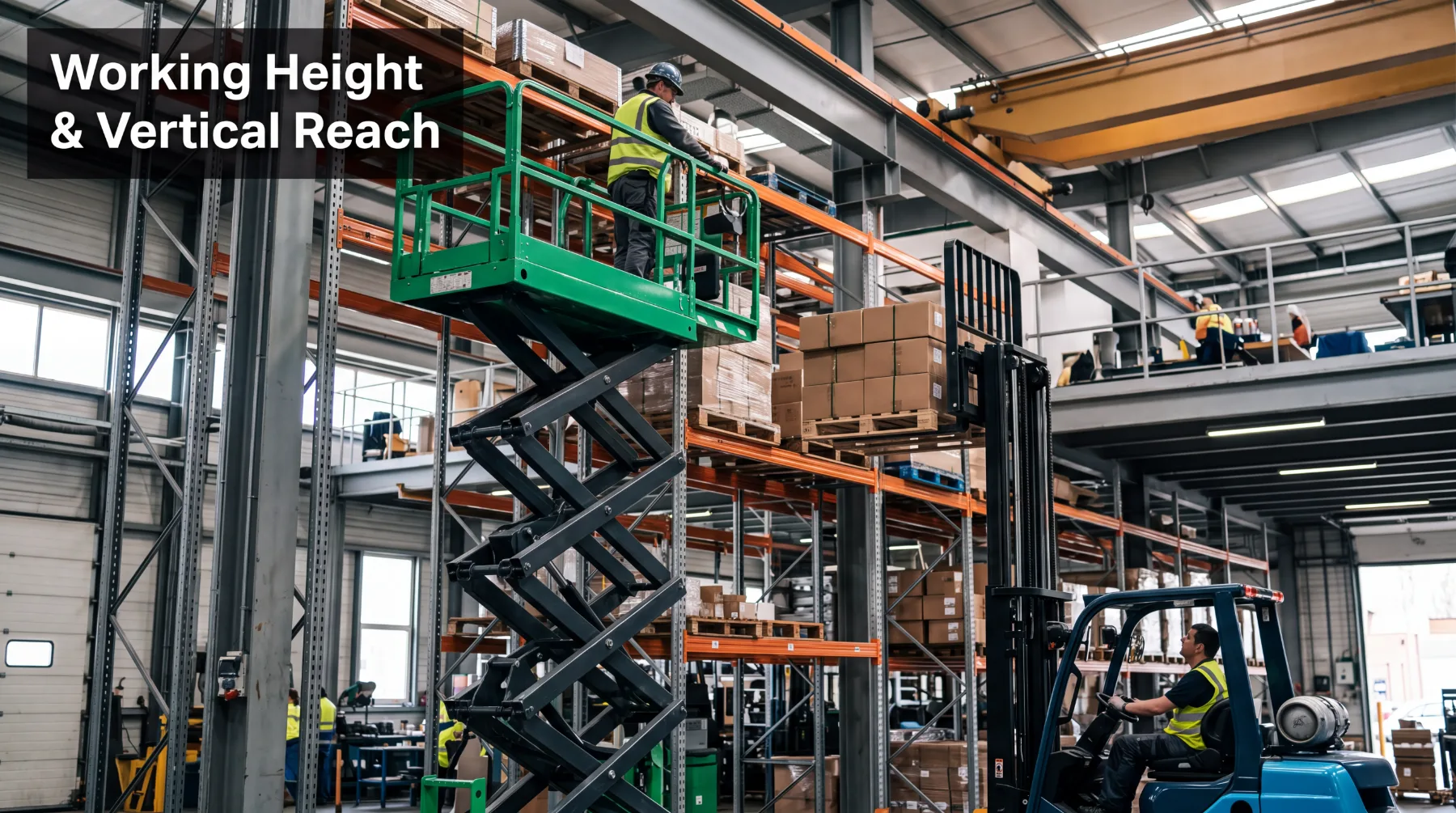
Working height is where the difference between these machines becomes especially clear. Scissor lifts are designed to raise workers and equipment vertically to elevated work areas, giving people a stable platform from which to perform tasks at height. The platform rises straight up on its scissor mechanism, and the working height describes how high that platform can carry workers to reach ceilings, walls, overhead fixtures, and similar elevated points. This vertical travel is the machine’s core purpose.
Forklifts approach height from a different angle. They are primarily designed to lift and move materials, and their fork lifting height describes how high the forks can raise a load for stacking, storage, or loading. While a forklift can reach considerable heights to place material on racking or into a truck bed, it is doing so to position a load, not to support a person working at that level. The two height figures measure different things and serve different goals.
Matching the machine to your application means being precise about what you need to reach and why. If the job calls for workers to spend time at height, performing installation, maintenance, or finishing work, the scissor lift’s platform height is the figure to evaluate. Confirm that the machine can carry personnel comfortably to the level where the work happens, with enough reach to complete the task safely. If the job calls for placing or retrieving loads at elevation, the forklift’s fork lifting height is what counts. Check that the forks can raise your material to the required storage or loading height. Defining the required platform height or fork lifting height for your specific application removes the guesswork and steers you toward the machine designed to reach the way your work demands.
Stability During Lifting Operations
Stability is central to safe, reliable lifting, and several factors work together to determine how steady a machine remains during operation. Machine design comes first. Scissor lifts and forklifts are engineered with different footprints, weight distributions, and support structures suited to their respective tasks. A scissor lift is built to hold a raised platform steady, while a forklift is designed to counterbalance a load carried out in front of it. Understanding how each machine achieves stability helps you evaluate its performance on a given job.
Load distribution plays an equally important role. On a scissor lift, weight spread evenly across the platform supports stable lifting, while concentrated or uneven loads can affect balance. On a forklift, how the load sits on the forks and where its weight centers directly influence stability, since a load carried too far forward or unevenly can compromise the machine’s balance. Handling loads within the machine’s rated limits and following proper loading practices is essential to keeping either machine steady.
Ground conditions and operating configuration round out the picture. Firm, level ground provides the foundation both machines need for stable lifting, while soft, uneven, or sloped surfaces can undermine stability and demand extra care. The way a machine is set up for the task, including how it is positioned and whether it is used within its intended operating range, also affects how steadily it performs. Evaluating stability on a specific jobsite means considering all of these factors together rather than any single one. When you account for machine design, load distribution, ground conditions, and operating configuration as a connected whole, you gain a realistic understanding of how each machine will perform where the lifting actually takes place, which is exactly what safe operation requires.
Maneuverability and Jobsite Conditions
How a machine moves around a jobsite shapes its usefulness as much as how it lifts. Forklifts are commonly used for moving loads across warehouses, yards, and construction sites, carrying material from one point to another efficiently. Their strength lies in transporting weight over distance, weaving between racking, crossing open yards, and delivering loads where they are needed. A scissor lift serves a different role, providing a stable elevated platform for overhead work rather than moving loads across the site. It positions workers at height in a fixed location, then relocates as the work progresses.
Jobsite conditions have a strong influence on which machine suits the space. Access width determines whether a machine can reach the work area at all, since tight aisles, narrow gateways, and confined spaces limit what can fit. Surface conditions matter too, as smooth, firm floors suit some machines while rough or uneven ground calls for equipment designed to handle it. Available working space affects how easily a machine can position itself and operate once it arrives.
Weigh these conditions carefully when comparing the two machines for a site:
- Access width, meaning whether the machine can physically reach the work area through the available openings and aisles
- Surface conditions, including whether the ground is smooth and firm or rough, uneven, and demanding
- Working space, or how much room the machine needs to position itself and perform its task
Matching the machine to the actual conditions of your site keeps the work efficient and safe. A forklift suited to your yard or warehouse moves material smoothly across the space, while a scissor lift matched to your access and surface conditions positions workers at height reliably. Comparing the real conditions of your jobsite against what each machine needs reveals which one will operate most effectively where your work takes place.
Choosing Equipment for the Intended Task
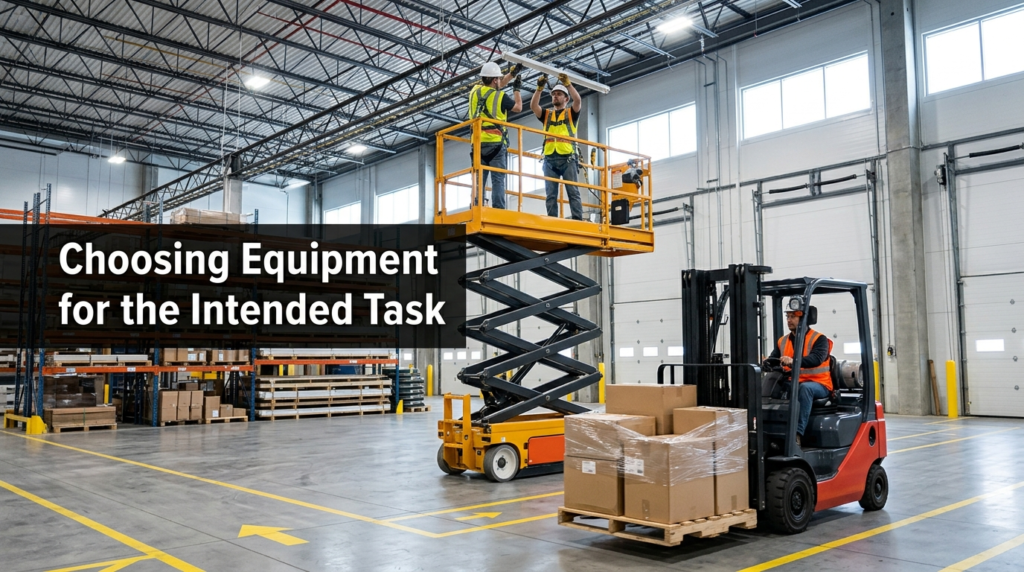
There is no single lifting setup that fits every application, which is why matching the equipment to the task is the most important step in the decision. A scissor lift and a forklift are built for different purposes, and each performs best when used for the work it was designed to handle. Trying to force one machine into the other’s role leads to compromised performance and, more seriously, safety risks. The clearest path to the right choice is defining your primary task and load requirements, then selecting the machine built to meet them.
A scissor lift is generally suited to elevated personnel work. When the job involves getting workers safely to an elevated position to perform tasks such as installation, maintenance, inspection, or finishing, the scissor lift provides the stable platform and vertical reach that work requires. Its purpose is to support people and their equipment at height, and it does that job dependably when matched to the platform height and capacity the task demands.
A forklift is intended for lifting and transporting materials. When the job centers on moving heavy loads, stacking pallets, loading trucks, or positioning material at storage heights, the forklift delivers the lifting capacity and mobility the work calls for. Its strength lies in handling weight efficiently and placing it where it needs to go.
The decision comes down to the nature of the work. Ask whether your primary task is elevating personnel or handling materials, then consider the weight, dimensions, and reach your loads require. When equipment selection matches the primary task and load requirements, you get a machine that performs its job safely and efficiently. This straightforward approach, grounded in what the work actually demands, leads to the right choice every time.
Conclusion
Comparing a scissor lift and a forklift is less about which offers better lifting performance overall and more about which is right for your specific task. A scissor lift excels at raising workers and equipment to elevated work areas on a stable platform, making it the choice for personnel access and overhead work. A forklift is built to lift and transport materials efficiently, handling heavy loads and placing them at storage or loading heights. Their lifting capacity, working height, stability, and maneuverability all reflect these distinct purposes, so the better machine is the one matched to the job.
Before selecting equipment for your next project, take an honest look at the work involved. Define whether your primary task is elevating personnel or handling materials, confirm the weight and dimensions of your loads, and consider the height you need to reach and the conditions of your jobsite. When you match the machine to those requirements, you gain equipment that performs safely, reliably, and efficiently. That thoughtful match is the foundation of dependable lifting performance on any site.
Frequently Asked Questions
1. What is the main difference between a scissor lift and a forklift?
The main difference comes down to purpose. A scissor lift is designed to raise workers, their tools, and materials vertically on a platform to an elevated work area, giving people a stable surface from which to perform tasks at height. Its scissor mechanism lifts the platform straight up, and its rated capacity accounts for the combined weight of everything on that platform. A forklift, by contrast, is built to lift and transport materials. Its forks raise heavy loads such as pallets and crates for stacking, storage, or loading, and its rated capacity describes how much weight it can carry, often at a specified load center. In short, a scissor lift is primarily a personnel access machine that provides a stable elevated platform for overhead work, while a forklift is a material handling machine that moves and lifts loads across a site. Because they serve such different roles, the right choice depends entirely on whether your job centers on getting workers to height or on moving and positioning materials. Understanding this fundamental distinction is the starting point for selecting the machine that fits your work.
2. Which machine can lift heavier loads?
A forklift is generally engineered to handle heavier, concentrated loads. It is built specifically to lift dense material such as loaded pallets, crates, and bulk goods, raising them efficiently to storage or loading heights, so its rated lifting capacity reflects that heavy-duty purpose. A scissor lift is not designed for the same kind of concentrated material handling. Its capacity is intended to support personnel, tools, and lighter equipment spread across the area of its platform, providing a stable working surface at height rather than lifting a single heavy load. That said, comparing the two on raw weight alone can be misleading, because they are built for different jobs. The more useful question is what type of load you need to move and why. If the task involves lifting substantial weight from place to place or stacking heavy material, the forklift’s capacity is what matters. If the task involves supporting workers and their equipment at height, the scissor lift’s platform capacity is the relevant figure. Always confirm that whichever machine you choose can safely handle the specific weight your work requires, staying within its rated limits for safe operation.
3. How do I know which working height I need?
Determining the right working height starts with defining exactly what you need to reach and why. If the job requires workers to spend time at height performing tasks such as installation, maintenance, inspection, or finishing, you should evaluate a scissor lift’s platform height. This figure tells you how high the machine can carry personnel to reach ceilings, walls, overhead fixtures, and similar elevated points. Confirm that the platform can bring workers comfortably to the level where the work happens, with enough reach to complete the task safely. If instead the job involves placing or retrieving loads at elevation, such as stacking pallets on racking or loading a truck, you should evaluate a forklift’s fork lifting height. This describes how high the forks can raise a load for storage or loading. The two measurements serve different goals, so being precise about your application removes the guesswork. Measure the actual height at which the work or load placement needs to occur, then choose the machine whose rated height comfortably meets that requirement. Matching the working height to your specific task ensures the machine can reach the way your work demands.
4. What affects the stability of these machines during lifting?
Several factors work together to determine stability during lifting. Machine design is the foundation, since scissor lifts and forklifts are engineered with different footprints, weight distributions, and support structures suited to their tasks. A scissor lift is built to hold a raised platform steady, while a forklift is designed to counterbalance a load carried in front of it. Load distribution is equally important. On a scissor lift, weight spread evenly across the platform supports stable lifting, while concentrated or uneven loads can affect balance. On a forklift, how the load sits on the forks and where its weight centers directly influence stability. Ground conditions matter as well, since firm, level ground provides the foundation both machines need, while soft, uneven, or sloped surfaces can undermine stability and call for extra care. Finally, operating configuration, including how the machine is positioned and whether it is used within its intended range, affects how steadily it performs. Evaluating stability on a specific jobsite means considering all these factors together rather than any single one. Handling loads within rated limits and following proper operating practices are essential to keeping either machine steady and safe.
5. Can one machine do the job of the other?
In most cases, no, because scissor lifts and forklifts are built for genuinely different purposes, and using one in place of the other leads to compromised performance and safety risks. A scissor lift is designed for elevated personnel work, providing a stable platform and vertical reach that support workers performing tasks at height. It is not intended to move heavy material across a site the way a forklift does. A forklift is designed to lift and transport materials, handling weight efficiently and placing it at storage or loading heights, but it is not built to serve as a safe, stable working platform for personnel at height. Trying to force either machine into the other’s role undermines the very strengths that make it effective and can create serious hazards. The right approach is to match the equipment to your primary task and load requirements. Ask whether the work centers on elevating personnel or handling materials, then choose the machine built for that purpose. When you select equipment based on the actual nature of the work, each machine performs its intended job safely and efficiently, which is exactly what dependable lifting performance requires.