Currently Empty: $0.00
Why Wheel Loader Load Capacity Is Different at Different Reach Heights
A wheel loader that handles a full bucket at ground level can struggle with the same load raised high or extended out front. That difference catches many crews off guard, and it can lead to tipping, spillage, or damaged equipment. Load capacity is not a single fixed number. It shifts with reach height, load center, and how the machine carries its weight through a lift cycle.
Understanding why capacity changes protects your crew, your machine, and your schedule. In this guide, you will learn how machine balance, lift height, load center, and hydraulic performance all work together to shape what your loader can safely handle at any given position, and why manufacturer load charts should guide every lift.
Load Capacity and Machine Balance
A wheel loader’s safe lifting capacity comes down to balance. The machine acts like a lever, with the front axle serving as the pivot point. The load sits out front, while the loader’s own weight, along with any counterweight at the rear, works to keep everything stable. When these forces stay in balance, the machine lifts and carries safely. When the load overpowers the machine’s stabilizing weight, the loader tips forward.
The key factor here is leverage. As a load moves farther away from the machine, it creates greater turning force against that front-axle pivot. A load held close is easy to control. The same load pushed out or lifted high multiplies the strain on the machine’s balance, even though the load itself never got heavier.
This is why rated capacity is always tied to position, not just weight. Several elements influence how well a loader maintains its balance under load:
- Counterweight at the rear that offsets the load out front
- Wheelbase and axle spacing that affect the machine’s leverage
- Tire condition and pressure that influence stability and footing
- Ground slope and surface that shift the balance point during operation
Operators who understand this relationship make smarter decisions in the field. Carrying a load low and close keeps the machine stable and responsive. Reaching or lifting too aggressively erodes that stability fast. Balance is the foundation of every safe lift, and it explains why the same loader can feel confident at one position and unstable at another.
How Lift Height Changes Load Stability
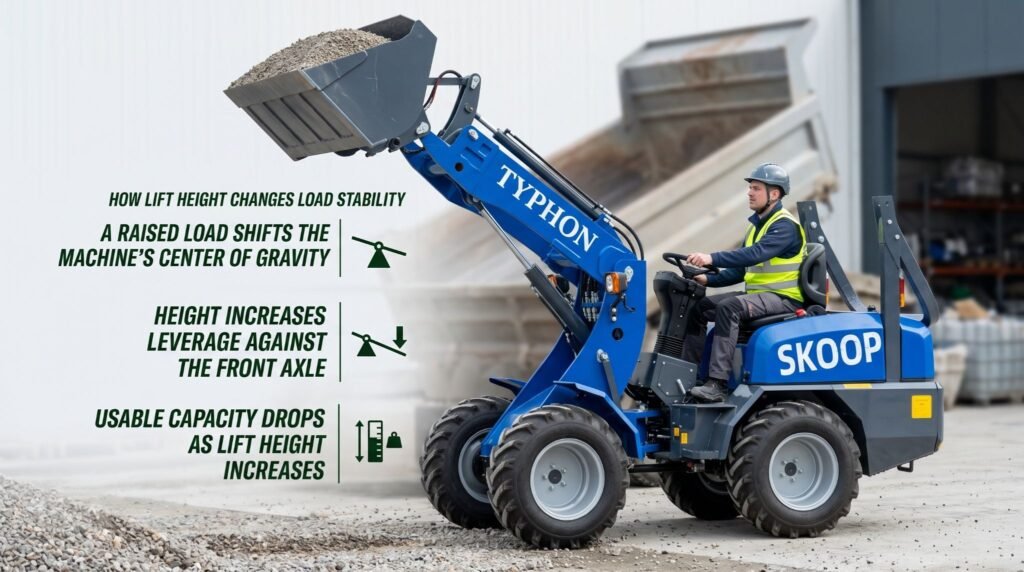
Raising the boom does more than move the load upward. It changes where the load sits relative to the machine’s center of gravity, and that shift directly affects stability. At ground level, the load stays low and contributes little to any tipping tendency. As the lift arms rise, the load climbs with them, and the machine’s balance point moves in response.
Height introduces two challenges at once. First, a raised load often moves forward as the lift geometry extends, increasing leverage against the front axle. Second, a higher center of gravity makes the whole machine more sensitive to slopes, sudden movements, and uneven ground. A loader that feels planted with a bucket at carry height can feel noticeably tippier with that same bucket raised for loading a truck.
Because of this, most wheel loaders offer less usable capacity at greater heights than they do lower in the lift cycle. The exact reduction depends on the machine’s design, its counterweight, the attachment fitted, and the conditions on site. This is not a defect. It reflects the physics of moving weight higher and often farther from the pivot.
Practical operation accounts for these changes. Lift smoothly rather than jerking the boom, since abrupt movements at height can upset a load that a load chart shows as safe under steady conditions. Keep the machine level when lifting high, and avoid turning or traveling at speed with a raised load. Recognizing that stability drops as height rises helps operators respect the limits their machine works within, especially during high lifts over trucks or hoppers.
The Effect of Load Center
Load center is one of the most important concepts in understanding capacity, yet it is often overlooked. It refers to the horizontal distance between the load’s center of gravity and a fixed reference point on the machine, typically the lift-arm pivot or the front axle. This distance determines how much tipping force the load generates.
A short load center keeps the weight close to the machine, minimizing leverage and preserving capacity. A greater load center pushes the weight farther out, which increases the tipping forces acting against the front axle. The result is that two identical loads can place very different demands on the machine simply because of where their weight is concentrated.
Consider how load center changes in real work. A dense, compact material sits its weight close to the machine, giving a favorable load center. A bulky or awkwardly shaped load, or material carried in an oversized bucket, shifts that center of gravity farther forward. The heavier the load and the farther its center sits from the pivot, the greater the strain on stability.
Attachments play a major role here too. A pallet fork extends the load well ahead of where a standard bucket would place it, dramatically increasing the load center. This is why the same loader is rated for far less weight on forks than in a bucket. When you understand load center, you stop thinking about weight alone and start thinking about weight and distance together. That combination is what truly determines whether a lift stays safe or crosses into dangerous territory.
Hydraulic System and Lift Performance
The hydraulic system is what actually delivers the lifting force. It drives the cylinders that raise the lift arms and curl the bucket, converting engine power into the muscle that moves heavy loads. How effectively a loader lifts and holds weight at different heights depends heavily on how this system is built and maintained.
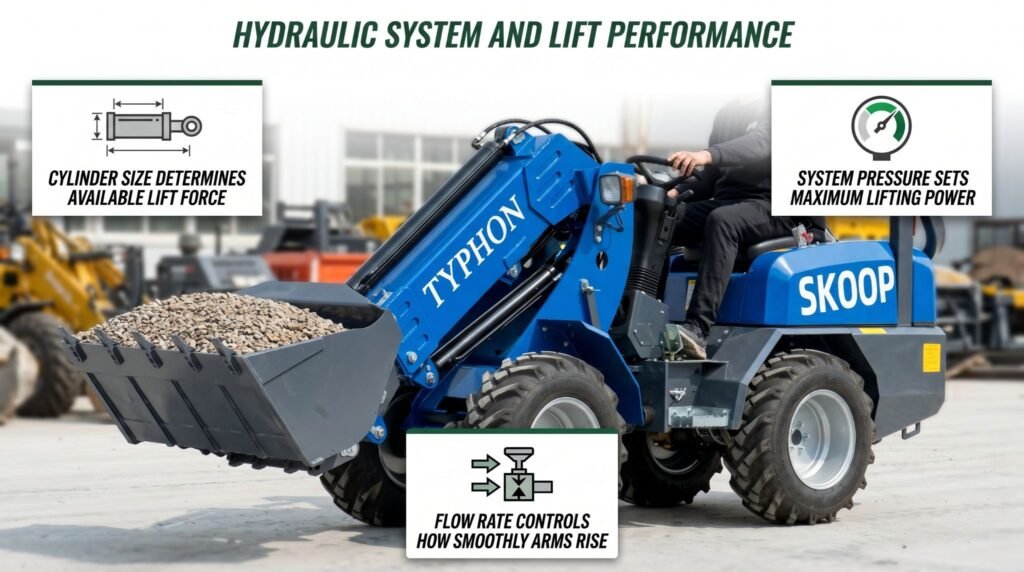
Three factors shape hydraulic lift performance:
- Cylinder size determines how much force the system can generate at the lift arms
- System pressure sets the maximum lifting force the hydraulics can produce
- Flow rate affects how quickly and smoothly the arms raise under load
These elements work together to define the machine’s lift capability. A loader with generous cylinder dimensions and strong system pressure can raise heavy loads confidently and hold them steady at height. When pressure runs low or components wear, lift performance drops, and the machine may struggle to raise or maintain a load it should handle easily.
Hydraulic performance also connects directly to safe capacity. Raising a load demands sustained force throughout the lift, not just at the start. A healthy system provides that force smoothly, while a weakened one can hesitate or drift, which undermines both control and safety. Leaks, contaminated fluid, or a worn pump all reduce the force available at the moment it matters most.
Regular maintenance keeps this system dependable. Check fluid levels and condition, watch for leaks around cylinders and hoses, and address any loss of lift power promptly. A loader can only lift to its rated capacity if the hydraulics are capable of delivering the force those ratings assume, so keeping the system strong protects both performance and safe operation at every reach height.
Using Rated Capacity Correctly
Everything discussed so far comes together in one practical tool: the manufacturer’s load chart. These charts and specifications show exactly how capacity changes with lift height, reach, attachment, and operating conditions. They exist because a single maximum number would be misleading, and relying on it could put your crew and machine at risk.
The most common mistake is assuming the maximum rated capacity applies at every position. It does not. A loader’s peak capacity typically applies under specific conditions, often at lower heights with a standard bucket and the load held close. Push beyond those conditions by lifting higher, reaching farther, or fitting a different attachment, and the safe capacity drops.
Reading the load chart correctly protects every lift. Match the chart to your actual setup by confirming the attachment, the lift height, and the reach position you plan to use. Then work within the rated figure for that specific position rather than the machine’s headline maximum. When conditions change, such as sloped ground or an unusual load shape, treat the rated capacity as a ceiling and stay comfortably below it.
Operators, fleet managers, and site supervisors all share responsibility here. Managers should ensure load charts stay accessible in the cab and that operators are trained to read them. Operators should check the chart whenever the task changes rather than relying on feel alone. Following rated specifications is not about limiting productivity. It is about lifting the right load at the right position every time, which prevents accidents, reduces machine wear, and keeps your jobsite running without costly interruptions.
Conclusion
Wheel loader capacity changes with position because balance, leverage, and load center all shift as a load moves higher or farther out. A loader that handles a heavy bucket close to the ground can safely carry far less when that same load is raised for truck loading or extended on forks. Understanding these forces helps your team lift smarter and safer.
The single most important habit is to trust the manufacturer’s load chart over assumptions. Before your next high or extended lift, confirm your attachment, height, and reach, then check the rated capacity for that exact position. Make that a standard step on your jobsite this week, and you will protect your crew, your equipment, and your schedule.
Frequently Asked Questions
1. Why can my wheel loader lift more at ground level than at full height?
At ground level, the load stays low and close to the machine, which keeps the center of gravity favorable and minimizes leverage against the front axle. As you raise the boom, the load often moves higher and farther forward, increasing tipping forces and raising the machine’s center of gravity. This reduces usable capacity. The physics of moving weight higher and outward, not any fault in the machine, explains the difference.
2. What is load center and why does it matter?
Load center is the horizontal distance between the load’s center of gravity and a fixed reference point on the machine, usually the lift-arm pivot or front axle. A greater load center increases the tipping forces acting on the loader. Two loads of equal weight can strain the machine very differently depending on how far their weight sits from the pivot, which is why load center matters as much as weight itself.
3. Why does my loader handle less weight on forks than in a bucket?
Pallet forks extend the load well ahead of where a standard bucket would place it, which significantly increases the load center. That greater distance multiplies the tipping force acting against the front axle, even if the weight is the same. As a result, manufacturers rate loaders for less weight on forks than in a bucket. Always check the load chart for your specific attachment before lifting.
4. How does the hydraulic system affect lifting capacity at height?
The hydraulic system supplies the force that raises and holds a load. Cylinder size, system pressure, and flow rate all determine how much weight the loader can lift and how steadily it holds that load at height. When pressure drops or components wear, lift performance falls, and the machine may struggle with loads it should handle. Regular maintenance keeps the hydraulics strong enough to meet rated capacity.
5. Where do I find the correct capacity for a specific lift height?
Check the manufacturer’s load chart, which shows how capacity changes with lift height, reach, attachment, and operating conditions. Keep the chart accessible in the cab and match it to your actual setup before each lift that differs from routine work. Never assume the maximum rated capacity applies at every position. Working within the rated figure for your exact height and reach keeps every lift safe.