Currently Empty: $0.00
Gear Pumps vs. Piston Pumps: How Pump Type Changes Engine Demand
A quarry mechanic stands beside two excavators that share the same engine, the same bucket, and nearly the same spec sheet, yet the fuel logs tell two different stories. One machine burns noticeably more diesel through a shift of steady digging, while the other holds a leaner number doing the exact same work. The operators are equally skilled, the loads are equally heavy, and the ground is equally hard. The difference hides deep inside each machine, in the hydraulic pump that feeds every cylinder and motor on board. One runs a gear pump, the other a piston pump, and that single component quietly shapes how hard each engine must work all day long.
Pumps rarely earn a second thought from buyers, who focus on horsepower, bucket size, and reach. But the pump is the heart of a machine’s hydraulic system, converting engine power into the pressurized flow that does the actual work. How efficiently it makes that conversion decides how much of the engine’s output reaches the job and how much simply burns away as heat and waste.
That gap between a pump that sips power and one that spends it freely is exactly where fuel bills grow or shrink over a machine’s life. Understanding the two dominant pump types, and how each draws on the engine, is what separates a smart equipment decision from an expensive assumption.
Pump type shapes engine demand more directly than most operators realize, because the pump sits between the engine and every hydraulic function the machine performs. Knowing how gear and piston pumps differ, and what each asks of the engine, helps you buy, operate, and maintain equipment with real confidence.
Pump Performance and Engine Effort
Conversion is the pump’s whole reason for existing, since a diesel engine produces rotating power that no cylinder or hydraulic motor can use directly. The pump takes that spinning shaft and turns it into pressurized fluid flow, the form of energy that curls a bucket, drives a track, or swings a house. Every hydraulic action on the machine begins at the pump, so its behavior touches everything the equipment does.
Load on the engine flows straight from how the pump does that job, because a pump that wastes energy forces the engine to make up the difference. When a pump leaks internal pressure, generates excess heat, or moves fluid the machine does not need at that moment, the engine burns fuel producing power that never reaches the work. A pump matched well to the task lets the engine spend its output on digging and lifting rather than on losses.
Cost over the life of the machine traces back to this quiet relationship more than buyers expect, since a small efficiency gap compounds across thousands of operating hours. A pump that draws a little extra engine effort every minute adds up to real diesel spent and real heat that stresses the whole system. Key takeaway: the pump converts engine power into hydraulic flow, and how cleanly it makes that conversion decides how hard the engine works and how much fuel the machine burns.
How Gear Pumps Move Fluid Through Simple Design
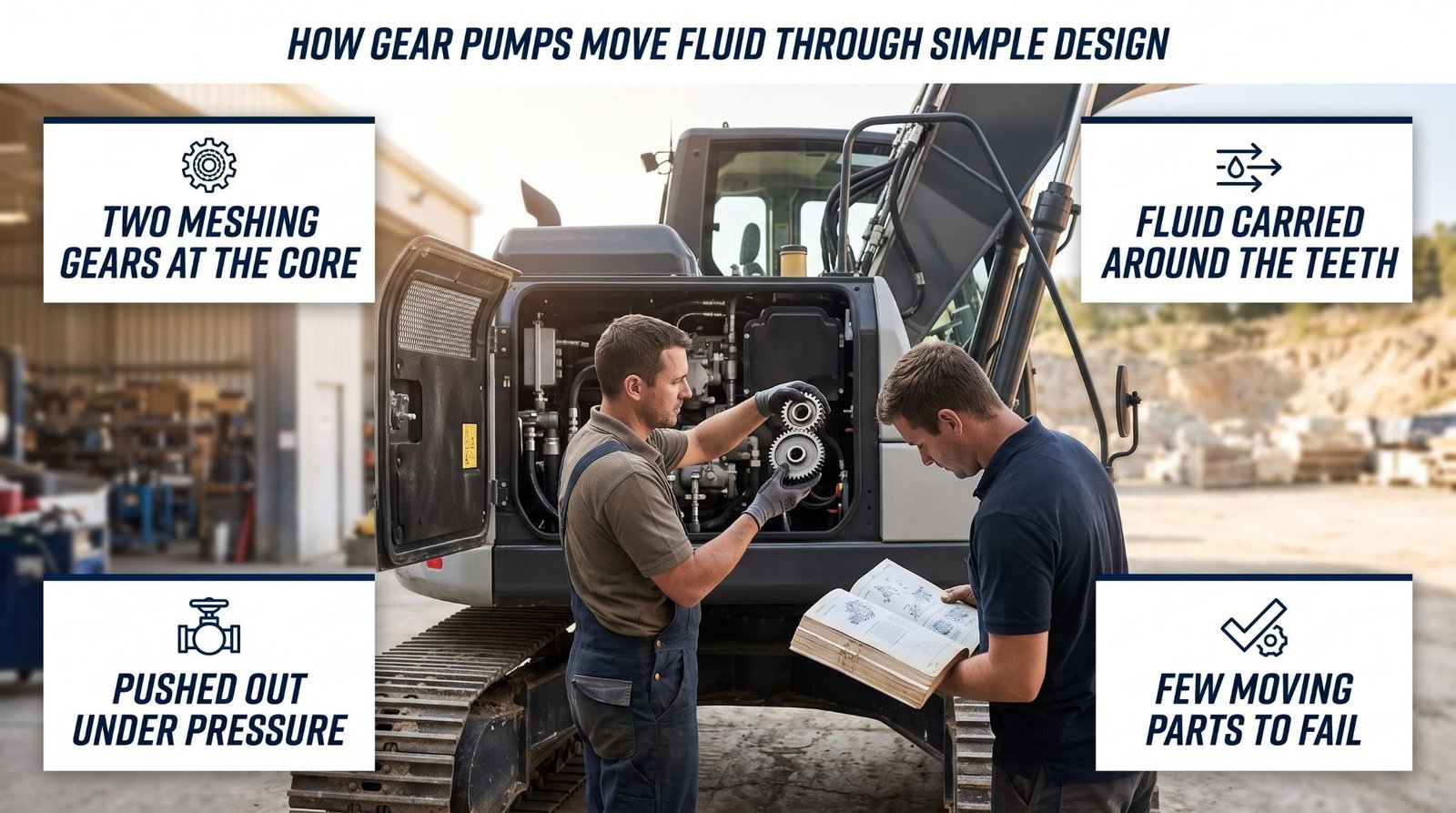
Meshing gears give this pump type both its name and its character, since two tightly fitted gears turning against each other are the entire heart of the design. As the gears rotate, fluid gets trapped in the spaces between the teeth and the pump housing, carried around the outside, and pushed out under pressure at the outlet. The mechanism is elegant in its plainness, with few moving parts to fail.
Fixed displacement defines how a gear pump behaves, because it moves the same volume of fluid with every rotation regardless of what the machine actually needs. Whenever the engine turns the pump, it pushes a steady, unchanging flow, and any fluid the machine does not use gets routed back through a relief valve. This constant output makes the pump predictable, though it also means the pump keeps working even when the demand for flow drops.
Durability and low cost round out the gear pump’s appeal, which explains why it appears so widely across heavy equipment. The simple construction resists contamination better than more delicate designs, tolerates rough conditions, and costs far less to buy and repair than a complex pump. Key takeaway: a gear pump uses meshing gears to deliver a fixed, steady flow through a simple, rugged, and affordable design that keeps working reliably in demanding conditions.
How Piston Pumps Deliver Precision and Control
Consider the piston pump, and the picture shifts from plain gears to a set of small pistons sliding within a rotating cylinder block. Each piston draws fluid in as it retracts and forces it out under pressure as it extends, and the combined action of several pistons produces a smooth, high-pressure flow. This arrangement handles far greater pressures than a gear pump can manage, which suits the most demanding hydraulic work.
Variable displacement is the feature that truly sets a piston pump apart, because many designs can change how much fluid they move per rotation on the fly. By adjusting the angle of a swashplate against the pistons, the pump varies its output to match exactly what the machine needs at any moment, delivering full flow during a hard dig and easing back when the operator holds still. This ability to modulate flow is precisely what makes the pump so efficient.
Sophistication comes at a price, both in dollars and in care, which shapes where these pumps belong. The precise pistons, cylinder block, and swashplate cost more to build and demand cleaner fluid and closer maintenance than a rugged gear pump, yet they reward that investment with performance a simpler design cannot match. Key takeaway: a piston pump uses pistons and an adjustable swashplate to deliver high-pressure, variable flow that matches the machine’s needs precisely, trading higher cost and care for superior control.
Why Each Pump Draws on the Engine Differently
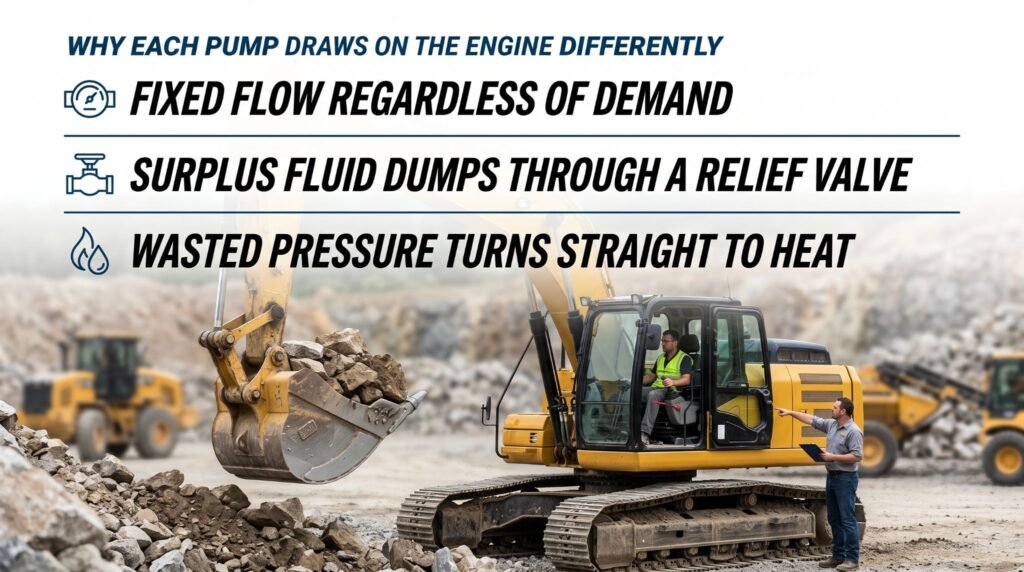
Demand behavior marks the sharpest divide between the two pump types, because a fixed pump and a variable pump ask entirely different things of the engine. A gear pump moves its full flow whenever it spins, so the engine must supply the power for that complete output even when the machine sits idle between motions. The pump does not know or care whether the operator needs that flow at that instant.
Wasted effort follows directly from that fixed behavior, since the surplus flow a gear pump produces has nowhere useful to go. When the machine needs less than the pump delivers, the excess fluid dumps across a relief valve, and the energy the engine spent pressurizing that fluid converts straight into heat rather than work. The engine burned diesel to push fluid the machine simply discarded.
Matched power is where a piston pump changes the equation, because a variable design draws only the engine effort the moment actually requires. When the operator pauses or works gently, the pump reduces its displacement, the engine feels a lighter load, and the diesel that would have vanished across a relief valve stays unburned. Key takeaway: a gear pump demands full engine power whenever it turns and wastes the surplus as heat, while a variable piston pump draws only the power the task needs, easing the load whenever demand falls.
Where Efficiency and Fuel Use Truly Diverge
Fuel tells the honest story of these differences, because the way each pump draws on the engine shows up plainly at the pump. A machine running a variable piston pump avoids the constant waste of dumping surplus flow, so across a shift of varied work, with its natural pauses and light moments, it burns measurably less diesel than a comparable machine forced to pressurize full flow all day. Those saved gallons repeat every shift the machine works.
Heat compounds the efficiency gap in ways that reach beyond the fuel tank, since energy lost across a relief valve becomes heat the system must shed. A gear pump churning surplus fluid raises hydraulic temperatures, which stresses seals, degrades oil faster, and can force the machine to work harder just to stay cool. A piston pump that avoids much of that waste runs cooler and treats the whole hydraulic system more gently.
Duty cycle decides how large the real-world gap grows, because the advantage of a variable pump depends entirely on how much the demand actually varies. A machine that works in constant, full-flow bursts sees a smaller difference, while one with frequent pauses and changing loads lets a piston pump shine, saving power at every quiet moment. Key takeaway: a variable piston pump generally burns less fuel and runs cooler by avoiding wasted flow, and the size of that advantage grows with how much the machine’s hydraulic demand rises and falls.
Choosing the Pump That Fits the Application
Selection begins with an honest look at the work and the budget, because neither pump wins every contest and the right choice flows from the job in front of you. A machine facing simple, steady hydraulic tasks on a tight budget may serve its owner perfectly with a rugged, affordable gear pump, while one running demanding, variable work over long hours often justifies the piston pump’s higher cost through the fuel it saves. Naming your real work and your priorities is the first practical step.
Application intensity steers much of the decision, since the pump’s efficiency advantage only pays off when the machine works hard enough and varies enough to use it. High-hour operations cycling through changing loads recover a piston pump’s premium through years of leaner fuel bills, whereas a machine used lightly or in short bursts may never save enough diesel to offset the added purchase price and closer maintenance. Weighing the intensity and the hours guards against paying for efficiency you cannot use.
Maintenance capability and conditions round out the choice, because the finest pump on paper fails if the operation cannot support it. A piston pump demands clean fluid, disciplined filter changes, and careful service, so a business without that discipline, or one working in extremely dirty conditions, may find a forgiving gear pump the wiser and more dependable partner. Key takeaway: choosing between a gear pump and a piston pump means weighing your work intensity, operating hours, budget, and maintenance capability together, so the pump fits both the job and the operation that runs it.
Conclusion
Gear and piston pumps give heavy equipment two very different ways to turn engine power into hydraulic work, and the full picture holds once you follow each piece in turn. Start by recognizing why the pump quietly governs engine effort, converting rotation into flow and deciding how much fuel that conversion costs. Understand how a gear pump delivers a fixed, steady flow through a simple, rugged design, and how a piston pump delivers variable, high-pressure flow through precise pistons and an adjustable swashplate. Weigh how each draws on the engine differently, since a gear pump demands full power and wastes the surplus while a variable piston pump draws only what the task needs. Account for the efficiency and fuel differences, where the piston pump runs leaner and cooler on varied work, then match the pump to your intensity, hours, budget, and maintenance capability. Attend to all six, and you buy and run a machine whose hydraulics fit the work rather than fight it. Before your next purchase, define your typical duty cycle, weigh the fuel savings against the cost, and confirm your service capability so the machine performs from the first hour. When you’re ready to put dependable equipment with the right hydraulic pump to work, reach out to a trusted equipment specialist who can match reliable equipment to the results your work depends on.
Frequently Asked Questions
Does a piston pump really save fuel compared to a gear pump?
Often, yes. A variable piston pump adjusts flow to demand, reducing wasted power and fuel during light or idle periods. Savings are smaller during constant, full-flow work.
What is the main difference between a gear pump and a piston pump?
A gear pump provides fixed flow with a simple, rugged design. A piston pump can vary flow, handle higher pressures, and operate more efficiently, but costs more and needs cleaner fluid.
Which pump type should I choose for my equipment?
Choose a gear pump for simple, steady work and lower costs. Choose a piston pump for long hours, variable loads, and demanding work where efficiency matters.